Sacramental Union and Handling of the Elements
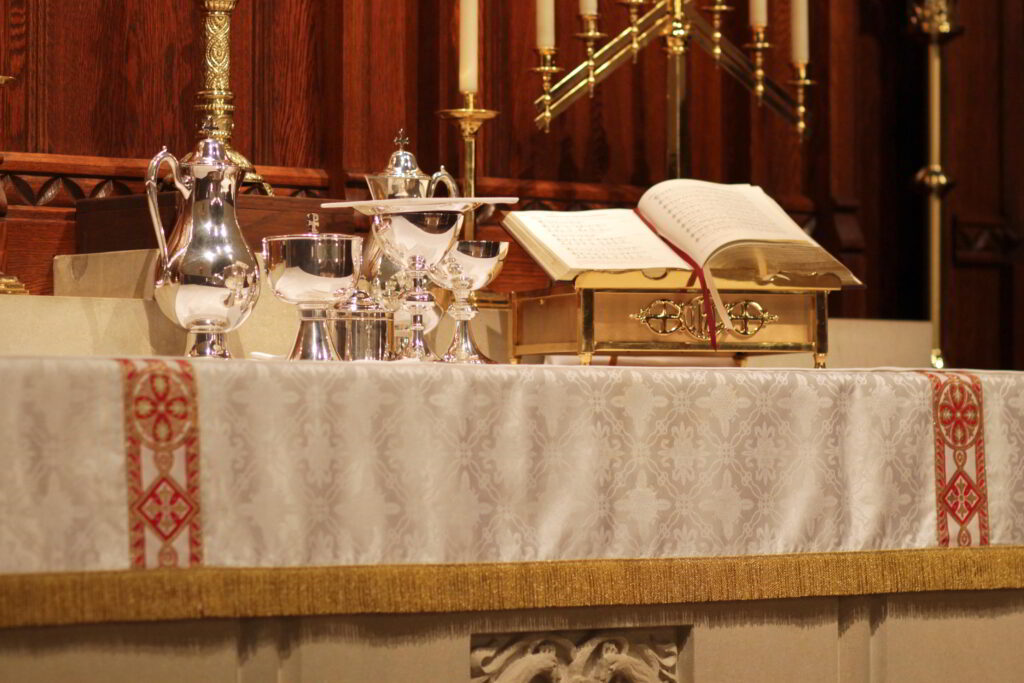 The Sacrament of the Altar. The Lord’s Supper. The Eucharist. The blessing of all blessings that the Lord Jesus Christ has given to His Church. Throughout our Lenten journey through the Paschal Mystery, the sermons on Sunday have been focused on this particular Sacrament. So far the posts on this blog have also been prepared in regard to a more in-depth study of the Lord’s Supper. Here are the questions we will now consider: 1) When does the sacramental union of the Body and Blood of Christ with the bread and wine of the Holy Eucharist begin? 2) How should we handle the elements used in the Sacrament?
While it might seem obvious, it’s important to note that our Lutheran Confession admit only the fourfold account of the institution of the Lord’s Supper (Matthew 26:26-28; Mark 14:22-24; Luke 22:19-20; 1 Corinthians 11:23-25) as the only source for the doctrine of the sacramental union. Now, the tenses of the verbs used in each Scriptural account does not render it possible to arrive at a conclusive answer to the question of the exact moment.
Two weighty doctors of the Lutheran Church provide insightful declarations that no dogmatic answer to this question can be given. Johann Gerhard (1582-1637) writes: “[Christian simplicity] is not gravely concerned about the moments in which the Body of Christ begins or ceases to be present, but just as the mode of the presence defies research, so also it declares that these questions about the moment of the presence are unanswerable.” Johann Wilhelm Baier (1647-1695) similarly asserts: “[It is] not necessary to define the moment of time in which the Body and the Blood of Christ begin to be sacramentally united with the bread and the wine.”
Martin Luther and his supporters (ourselves as well, as we are the inheritors of the faithful doctrine of the Lord’s Supper) rightly held that the sacramental union of Christ’s Body and Blood with the bread and wine is accomplished in close temporal and causal connection with the recitation of the words of institution.
Throughout his writings, Martin Luther insisted that after the words of institution were spoken, by the power of God’s Word, the true presence of Christ’s Body and Blood had been united to the bread and wine. Particularly interesting writings include his 1520 On the Babylonian Captivity of the Church, where Luther affirmed that the Body and Blood of Christ were present at the time of the elevation—when the pastor raises the host and the chalice after the words of institution. Luther’s catechism sermon on the Holy Eucharist (September 25, 1528) describes the Body of Christ as clothing itself with the bread when the Word is added to the elements.
While we cannot definitively state the exact moment that Christ’s true Body and Blood are present in the Sacrament, we do know that after the words of institution are spoken, and before the elements are placed into our mouth, Christ truly is present. Article X of the Augsburg Confession asserts that the Body and Blood of Christ are truly present in the Lord’s Supper under the form of the bread and wine and that they are distributed to and received by all the communicants. The assertion that Article X of the Augsburg Confession implies that the Body and Blood of Christ are present “in the hands of the administrant as well in the mouth of the communicant” was endorsed by the 22 LCMS participants (including C. F. W. Walther) in the second assembly of the Free Evangelical Lutheran Conference, Pittsburgh, PA, Oct. 28 to Nov. 4, 1857.
How then should we handle the elements used in the Lord’s Supper? With supreme reverence and care! For we know that the true presence of our Lord Jesus Christ is present! Here is a story that helps to shed some light on this topic. In 1542 at St. Mary’s Church in Wittenberg, Martin Luther and Johannes Bugenhagen were celebrating the Lord’s Supper with the parish. A woman communicant accidentally bumped against the chalice as she was kneeling down so that some of its contents spilled upon her clothing. Luther and Bugenhagen assisted in wiping off the woman’s jacket. After the celebration Luther had the affected portion of the lining of the jacket cut out and burned, along with the wood that he had shaved from the part of the choir stall upon which the contents of the chalice had likewise been splashed. In 1530, Luther had a host which had been placed into the mouth of a dying parishioner burned because the individual died before he could swallow.
The continual tradition of the Lutheran Church has been to display great care and reverence to the elements used in the Lord’s Supper. At St. Mary’s Lutheran Church in Wittenberg—and wherever the Lutheran Reformers taught—the preferred practice for treatment of the remaining communion elements after the last parishioner communed was to have them consumed by the pastor(s) and elders. Luther and Bugenhagen explained that to avoid having hosts left over they counted out the hosts to match the number of communicants at each service.
So here we see the great and deliberate care that is taken when handling the elements used for the Sacrament of the Altar. We are careful and reverent because the true Body and Blood of Jesus Christ is present with the bread and the wine. People loved by God, when you come to altar and receive the host and the wine…you hold Jesus in your hands! There He is! Exactly where He has promised to be. And He delights to come to you in such a way to deliver to You forgiveness, unity with Him, His divine grace, and the promise of eternal life. You hold in your hands the most sacred and precious thing in all of the world! And you get to place that treasure of infinite worth into your own mouth!
In summary: As Lutherans we cannot assert less than that the true Body and Blood of Christ are truly and essentially present in the Eucharist and that with the consecrated bread and wine they are distributed to and received by all who use the Sacrament.
Any attempt at defining the precise moment at which the sacramental union begins—at consecration, at the beginning of distribution, or any point in between—must remain in the realm of theological opinion.
Finally, we must be sure to also handle the communion elements with the utmost care and reverence. Rejoicing in the great gift that our Lord Jesus Christ Himself delivers to us. May we all look forward to receiving this blessing of all blessings again soon!
The Lord’s Supper During A Pandemic
 The COVID-19 pandemic that shut down Michigan in March, 2020, changed and challenged many church practices that most of us took for granted. One of the most significant impacts was on the celebration of the Lord’s Supper. Christians have been celebrating the Lord’s Supper for 2,000 years, through plagues, pandemics, wars, and all sorts of calamities, so this is not a new challenge for Christians. It is new, however, to our generation, which has not had so many hurdles set up to receiving the Lord’s Supper in our lifetime. A greater understanding of health and cleanliness also makes our generation distinct in the ways we are challenged by the restrictions of pandemic ministry.
The Lord’s Supper was instituted by Jesus Christ himself, when He celebrated it with His disciples and told them to “Do this in remembrance of me.” (Luke 22:19) We receive in the bread and wine the very body and blood of Christ, given and shed for us for the forgiveness of our sins and strengthening of faith, as well as the pledge of a resurrection life. The Lord’s Supper is something believers crave and hunger for, as it unites us with Jesus and each other. But what happens when a pandemic disrupts our regular reception of the sacrament?
During the stay-at-home orders, many Christians “fasted” from the Lord’s Supper, as did our congregation when we had only livestream services from March through June. Others have been worshipping online this entire year, due to health risks or other concerns. They plan to take the Lord’s Supper again once they have been fully vaccinated. Some have been in nursing homes or facilities where visitors have not been allowed. This past year, many Christians have gone the longest without the Lord’s Supper than ever before since their First Communion.
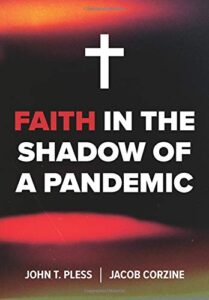 The book, Faith in the Shadow of a Pandemic (Corzine & Pless, CPH, 2020) treats the topic of the Lord’s Supper in an entire chapter. In it, they recall from the Scriptures and the Lutheran Confessions that we celebrate the Lord’s Supper from Christ’s institution, and are discouraged from “making stuff up” when it comes to the sacrament. This had already happened in extreme ways during the Middle Ages, when medieval Christianity had a number of innovations regarding the sacrament. They had private masses, reservation of the host, Corpus Christi processions, and reserved the wine for the priests only. These and other inventions were discarded by the Lutheran Reformation, which focused on the words given in Scripture.
In the Smalcald Articles, one of the confessional writings, it states, “If some want to justify their position by saying that they want to commune themselves for the sake of their own devotion, they cannot be taken seriously. For if they seriously desire to commune, then they do so with certainty and in the best way by using the sacrament administered according to Christ’s institution. On the contrary, to commune oneself is a human notion, uncertain, unnecessary, and even forbidden. Such people also do not know what they are doing, because they are following a false human notion and innovation without the sanction of God’s Word. This it is not right (even if everything else were otherwise in order) to use the common sacrament of the church for one’s own devotional life and to play with it according to one’s own pleasure apart from God’s Word and outside the church community.” (SA II II 8-9, Kolb Wengert p. 302-303)
In so many areas of ministry, we have had to be innovative, creative, and flexible to bring God’s Word and fulfill the mission of the church. These, no doubt, have been used by the Spirit for fruitful ministry. However, in the area of the Lord’s Supper, we are much more cautious about making too many changes that would undermine the basic elements of consecration and distribution. Yet even in this, not all churches will be identical in this regard. We try to demonstrate charity and grace to fellow Lutherans who may have decided to make more significant alterations to their consecration and distribution of the Lord’s Supper. All of us were trying our best to adapt to the situation. However, as we move forward, thoughtful reflection and theological discussions will need to be had with a spirit of humility and trust as we seek a faithful way forward.
Celebrating the Lord’s Supper at Our Savior Lutheran Church and School, Lansing, MI
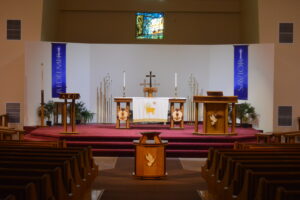
Holy Communion at Our Savior is offered to members of our congregation and to those who have been instructed in the beliefs and practices of our congregation and the Lutheran Church regarding the Sacrament. The practices of our congregation flow from our beliefs regarding what is happening in the celebration of the Lord’s Supper.
According to the Center for Disease Control at that time, touch was not a likely method for transmitting COVID-19. Transmission happens mainly through respiratory droplets breathed into the air, and mucous or saliva droplets spread through sneezing or touching one’s mouth, eyes, nose, etc. This made us focus on the three W’s that were consistent with the health measures that our school ministry had put in place – Wash your hands, Watch your distance, Wear your mask.
All Elders (and all communicants – everyone in worship actually) wash their hands thoroughly before worship and distributing the sacrament. Prior to distribution, pastors and elders use hand sanitizer to ensure our hands are clean before handling the wafers / host and the cups of wine. Masks are worn at all times by those distributing. Those communing may briefly remove their mask to receive the Sacrament. The brief time when communicants remove their mask to receive the sacrament is not a risk factor. We are confident that receiving Holy Communion with these health practices in place is not a source of transmission for COVID-19. The benefits of the Sacrament far outweigh any minute risk from being in person for worship or taking the Lord’s Supper.
The Common Cup is a concern in many people’s minds, and yet in the past it has not really been a source of transmission for colds or the flu. The alcohol in the wine reacting with the precious metals has long thought to mitigate germ transmission. The risk of catching something is very low, especially compared to the high transmission activities like shaking hands. However, since the invention of little individual cups, many people prefer that to the common cup because only the altar guild and pastor distributing touch the cups. The altar guild and the pastor/vicar use rigorous hand washing to ensure that their hands are clean. We are using the common cup only for consecration, and only the individual cups for distribution.
When approaching for Holy Communion, there are hash marks on the carpet of the center aisle. This is so households can keep 6 ft distance from each other while in line to come forward. They may stay together as a family/household while communing at each station.
When approaching the elder to receive the body of Christ, the communicant may remove their mask and lay their palm flat. The elder places the host into their hands and they then place it in their mouth.
When they move over to the wine station, the pastor/vicar sets out the number of individual cups of wine for that family and then steps back. They take the cups and drink the wine as the pastor speaks the words of distribution. There is a cup of white de-alcoholized wine on the tables for those who desire it. After receiving the blood of Christ, they put the empty cups in the baskets as you return to their seats.
We are confident that the distribution of the Lord’s Supper poses extremely low risk for transmission for COVID-19, and that we can receive the Sacrament joyfully, confidently, and in the fellowship of believers as Jesus gives us forgiveness, life, and salvation.
Questions that still remain for the future practice of the Lord’s Supper are: 1) When will we use the rails to kneel for the Lord’s Supper? 2) When will we fill the baptismal font for people to touch on their way to the rail? 3) When will we use the common cup again? These are in addition to the questions about how long we will require masks, distancing, and hand washing and all the other mitigation efforts that have become the new normal. We pray for the Spirit’s continued wisdom and guidance as we move forward in faith, hope, and love.
In addition to in-person worship service and the celebration of the Lord’s Supper as described above, our church staff also brings communion to people’s homes upon request, and to our shut-ins on a monthly basis. A special parking lot service on April 18 will provide yet another opportunity for people to receive the Lord’s Supper if they are not ready to participate at in-person services.
The disruption of these long-held practices forces us to revisit our beliefs and convictions about the Lord’s Supper and Jesus’ intention and institution of it. This can very well lead to a deeper appreciation for the Sacrament, and a renewed understanding of its place in the Christian life. That is the reason for our Sunday morning preaching series in Lent 2021 on various facets of the Lord’s Supper, and the ongoing invitation to gather at the table of the Lord. We pray that the Lord will continue to strengthen and bless our church as He feeds and sustains us, so that we may continue to be the body of Christ in the world.
Benefits of the Lord’s Supper
Greetings, people loved by God!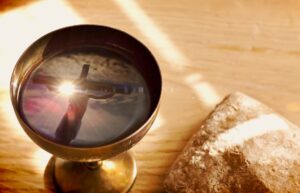
Welcome to the beginning of the Our Savior Lutheran blog. Pastor Wangelin and I (Vicar Heinze) will be using this blogsite first for a group of posts about the Lord’s Supper. These posts will be coming out along with our sermon series: Hungry Hearts, for Lent 2021.
Before we can dig into many of the topics we will be discussing in regard to the Lord’s Supper, it’s important for us to have a solid foundation of what the Lord’s Supper is and what the benefits of the Sacrament.
The Lord’s Supper goes by many names, both in Scripture and by the Church: The Lord’s Supper, the Sacrament of the Altar, the Eucharist, the breaking of the bread, etc. I have often heard the Sacrament of the Altar referred to as an “it” or “thing.” But it is much more a “Who.” In the Sacrament, we encounter Christ Himself. This is how the Small Catechism says the head of the home should teach the family about this great reality in a simple way:
What is the Sacrament of the Altar?
It is the true body and blood of our Lord Jesus Christ under the bread and wine, instituted by Christ Himself for us Christians to eat and to drink.
Where is this written?
In the same way also He took the cup after supper, and when He had given thanks, He gave it to them, saying, “Drink of it, all of you; this cup is the new testament in My blood, which is shed for you for the forgiveness of sins. This do, as often as you drink it, in remembrance of Me.”
As we read these words, we discover how simple they are; yet they are also very profound. Through these words, Jesus Christ Himself tells us exactly what He gives to us in the Sacrament and exactly why He gives it. Luther’s Small Catechism calls what He gives us “the true body and blood of our Lord Jesus Christ,” and the word “true” here is essential for any discussion on the Lord’s Supper. That words eliminates any attempt or ability to worm out of what Jesus actually says: “Take, eat; this is My body, which is given for you” and “Drink of it, all of you; this cup is the new testament in My blood, which is shed for you for the forgiveness of sin.” He tells us it is His body, and it is the body given for us. Think about that! The same body and blood that was born of the Blessed Virgin Mary! The same body that was crucified and nailed to the cross! The same blood that stained the wood, that poured from His wounds, that wiped out the sin of the world!
One of the most well-known Scripture accounts is Jesus’ teaching to become like little children, for they are known for believing what they are told. And when we come to the discussion of the Lord’s Supper, guess what…it’s time for each of us to become like little children again. In the Sacrament we are presented with an unfathomable mystery by Jesus Himself, yet an overwhelmingly delightful mystery. In the Lord’s Supper, it is Jesus Himself who takes His own body and blood that was used to win our salvation and gives them to us to deliver that salvation into us. Jesus holds it out to us, as the catechism says, “under the bread and wine” and tells us to eat and drink it.
Lord Jesus Christ, we humbly pray
That we may feast on You today;
Beneath these forms of bread and wine
Give us, who share this wondrous food,
Your body broken and Your blood,
The grateful peace of sins forgiven,
By faith Your Word has made us bold
To seize the gift of love retold;
All that You are we here receive,
And all we are to You we give.
— LSB 623:1-3
Do you see that as you read these words? Do you hear it as you sing them? Look and see how we confess that when we go to receive the Lord’s Supper, we do not receive an “it” but a “Him’! This hymn clearly states our confession that in the Sacrament we actually feast on Christ, His body and blood beneath bread and wine!
But why did Christ give us this gift and command us to “do it” “often” “in remembrance of” Him? The Small Catechism turns to that next:
What is the benefit of this eating and drinking?
These words, “Given and shed for you for the forgiveness of sins,” show us that in the Sacrament forgiveness of sins, life, and salvation are given us through these words. “For where there is forgiveness of sins, there is also life and salvation.”
Jesus’ words here, “Given and shed for you for the forgiveness of sins,” proclaim the foundational reason why He gives His body and blood to us in the Sacrament. We must make note that sometimes Christians have been confused in regard to an important distinction: the difference between how salvation was won and how salvation is bestowed. Obviously, there is absolutely no question that the salvation of the world was accomplished by Jesus Christ as He sacrificed Himself once-and-for-all on the cross.
However, if the salvation of the world was accomplished by Jesus on the cross two-thousand years ago, how is that salvation accessible to us now in the present day? Some of our Protestant friends like to sing a hymn that says: “There is power, power, wonder-working power in the blood of the Lamb.” We’d agree. There is! But we’d also ask: “And where can I find that blood?” In the Lord’s Supper, at His Altar, the Crucified and Risen Savior gives the salvation that He won by His once-for-all sacrifice on the cross.
Jesus’ sacrifice on the cross was offered only one time; however, in the Lord’s Supper, our same Living Lord comes to us every time with the very body and blood that were the ransom price of our bodies and souls; through them, He gives us His forgiveness. And, “where there is forgiveness of sins, there is also life and salvation.” Where the Son of God comes to you in love, gives you forgiveness, and pours into you His divine life, there you also discover salvation. Salvation is communion with the Father through the Holy Spirit.